
Konveyor aero-mekanikal:
Panduan lengkap tentang cara kerjanya, manfaat dan aplikasinya
Apa yang terdapat dalam panduan
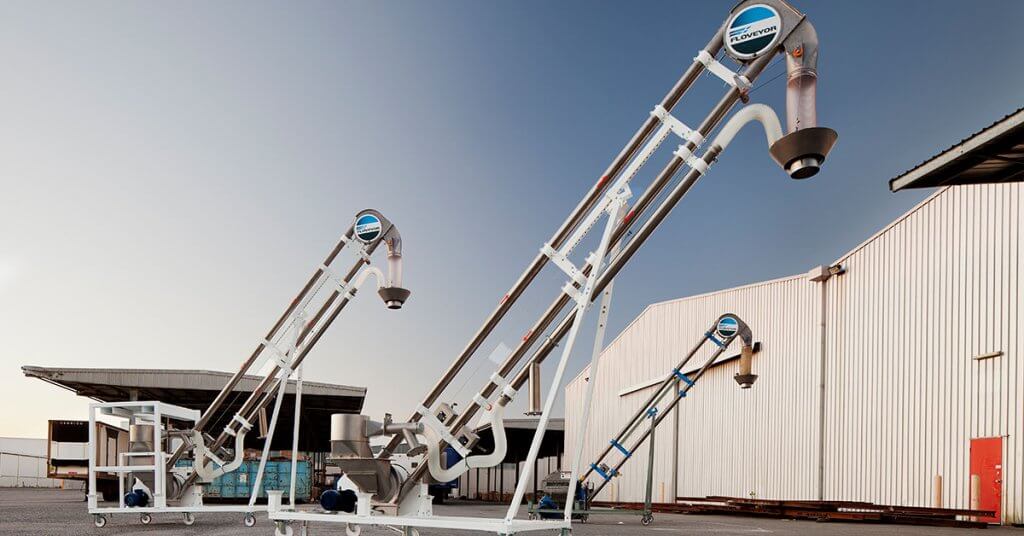
Pengangkut aero-mekanikal (AMC) ialah sistem pengendalian bahan pukal yang sepenuhnya tertutup yang menggunakan susunan tali dan cakera berkelajuan tinggi untuk menghasilkan poket udara bertekanan rendah di dalam tiub penghantar. Pokok udara itu menggantung dan mengangkut serbuk dan butiran dengan pantas, selamat dan lembut dari satu inlet ke satu titik pelepasan, dengan kerosakan produk yang minimum atau penghasilan habuk yang rendah. Floveyor mencipta konveyor aero-mekanikal di Perth, Australia Barat, pada tahun 1958 dan terus membangunkan teknologi itu sehingga hari ini.
Apakah itu konveyor aero-mekanikal?
Konveyor aero-mekanikal ialah satu kelas peralatan mekanikal pengendalian bahan pukal yang direka khas untuk memindahkan serbuk dan zarah kecil melalui tiub tertutup. Berbeza dengan sistem pneumatik yang menolak bahan di sepanjang aliran udara, atau konveyor skru dan tarikan yang menolak atau menariknya secara fizikal, AMC menggantung bahan di dalam tiub penghantaran dan membawanya dalam keadaan tergantung itu ke satu titik pelepasan. Ini menjadikannya sesuai untuk produk rapuh, campuran yang telah dicampur, dan serbuk yang sensitif terhadap pencemaran. AMC sesuai untuk industri makanan dan minuman, kimia, pertanian, pembuatan, dan pemprosesan mineral. Satu AMC boleh mengendalikan beribu-ribu bahan, campuran dan adunan yang berbeza, dan reka bentuknya yang tertutup sepenuhnya bermakna ia beroperasi tanpa habuk — satu pertimbangan penting untuk kebersihan produk dan keselamatan pekerja.
Bagaimana konveyor aero-mekanikal berfungsi
Prinsip kerja konveyor aero-mekanikal bergantung pada satu idea fizikal yang mudah: satu siri cakera yang terpisah secara sama rata bergerak pada kelajuan tinggi di dalam tiub tertutup menghasilkan poket udara bertekanan rendah di belakang setiap cakera. Bahan yang dimasukkan ke dalam aliran udara itu menjadi terampai dalam poket-poket tersebut dan dibawa bersama ke titik pelepasan, bukannya diseret, didorong atau ditiup. Pemindahan “terfluidisasi” inilah yang membolehkan AMC memindahkan bahan dengan pantas sambil mengehadkan sentuhan antara zarah dan badan konveyor kepada tahap minimum. Pada tahap paling asas, reka bentuk ini terdiri daripada tiub, tali, cakera, poket udara dan kelajuan. Dua bahagian seterusnya dalam panduan ini menerangkan bagaimana elemen-elemen tersebut berfungsi bersama dan komponen-komponennya sendiri.
Bagaimana konveyor aero-mekanikal berfungsi?
Motor memacu susunan tali yang beredar secara dalaman pada kelajuan tinggi di dalam tiub penghantar. Ini mewujudkan poket udara bertekanan rendah di belakang setiap cakera. Bahan pukal dimasukkan ke dalam sistem melalui satu inlet pada rumah pemakanan dan dipercepatkan ke dalam tiub penghantar oleh set tali. Bahan pukal digantung dalam kantung udara dan ditarik dengan pantas tetapi lembut ke satu titik pelepasan tunggal. Pengangkut aero-mekanikal dengan FloDisc® Teknologi ini mempunyai sentuhan bahan-ke-bahan atau bahan-ke-peralatan yang minimum atau tiada langsung. Ia adalah sistem pemindahan serbuk yang ideal, walaupun untuk bahan dengan sifat yang sukar.
Ketahui lebih lanjut mengapa FloDisc penting untuk penghantaran aero-mekanikal.
Komponen konveyor aeromekanikal dijelaskan
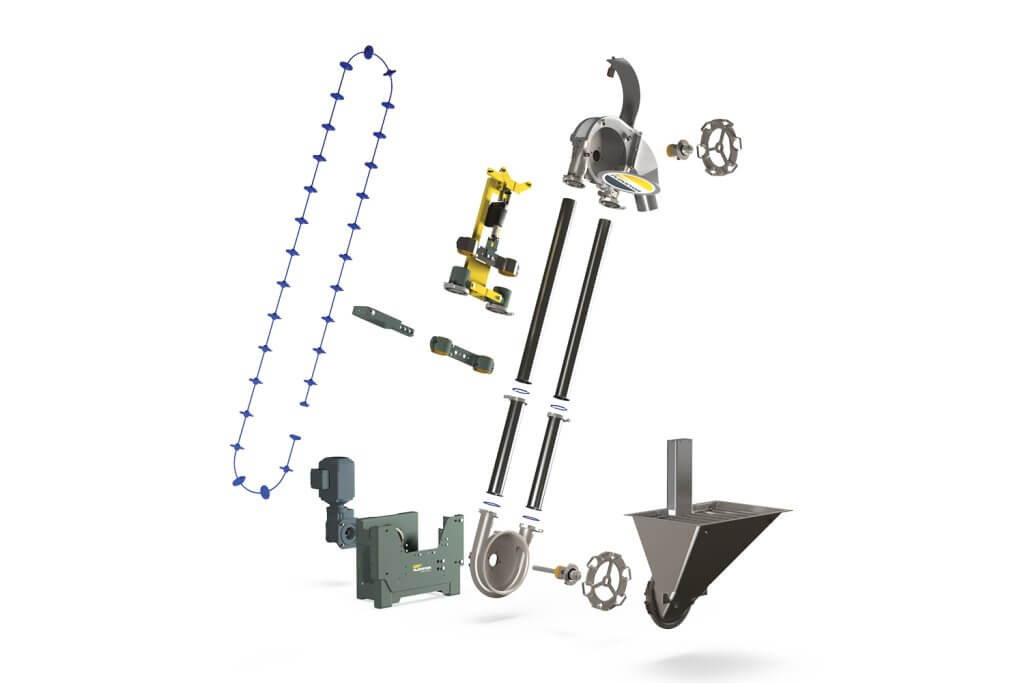
Komponen konveyor AMC terdiri daripada:
- Tiub: Tabung penghantaran utama adalah sistem gelung tertutup yang membentuk litar berterusan untuk pergerakan bahan.
- Cakera: Cakera poliuretana dicetak pada tali pada selang masa yang tetap. Cakera boleh dihasilkan menggunakan bahan binaan gred makanan. Cakera Polymag juga tersedia yang mempunyai keupayaan pengesanan sinar-X dan logam serta ketahanan kimia yang dipertingkatkan.
- Pemasangan tali: Cakera dicetak acuan suntikan pada susunan tali dalam gelung berterusan yang melalui tiub. Tali dihasilkan daripada keluli tergalvani atau keluli tahan karat dan boleh disaluti sepenuhnya, bersama cakera, untuk mengurangkan risiko pencemaran.
- Pemasukan dan keluaran: Lubang pada sistem konveyor aeromekanikal di mana bahan masuk dan keluar dari tiub. Ia direka untuk memudahkan pemuatan dan pembongkaran bahan pukal ke dan dari konveyor.
- Motor: Unit pemacu menyediakan kuasa untuk pergerakan rakitan tali, memacu cakera dan bahan melalui sistem penghantar. Ia penting untuk mengawal kelajuan dan arah aliran bahan.
- Sistem pengencangan: Sistem pengetegangan mengekalkan ketegangan yang betul pada tali untuk memastikan pengendalian pengangkut berjalan lancar. Terlalu longgar atau terlalu ketat menjejaskan prestasi dan boleh merosakkan AMC dari masa ke masa.
Bagaimana konveyor aero-mekanikal dibandingkan dengan konveyor pneumatik?
Berbanding dengan pengangkut pneumatik, pengangkut aeromekanikal biasanya menggunakan jauh lebih sedikit tenaga untuk menggerakkan isipadu bahan yang sama, sekali gus menurunkan kos operasi dan kos pemilikan keseluruhan.
- Sistem pneumatik bergantung pada volum dan kelajuan udara yang tinggi untuk mengangkut bahan dalam aliran udara.
- Sebaliknya, AMC memindahkan bahan secara mekanikal dalam suspensi, jadi ia lebih lembut terhadap produk.
Kelembutan itu paling penting bagi campuran pra-campur kerana AMC melepaskan bahan dalam nisbah yang sama seperti ia diberi makan. Turbulensi penghantaran pneumatik boleh memisahkan campuran dan merosakkan zarah rapuh. Kedua-dua sistem ini sepenuhnya tertutup dan bebas habuk. Pengangkutan pneumatik masih mempunyai kelebihan pada beberapa laluan yang sangat panjang atau sangat kompleks, jadi pilihan yang tepat bergantung kepada jarak, susun atur dan sejauh mana bahan anda sensitif.
Apakah kelebihan konveyor aero-mekanikal?
Konveyor aeromekanikal menawarkan sistem penghantaran serbuk yang unggul berbanding kaedah pengendalian serbuk lain. Konveyor aero-mekanikal adalah pilihan yang popular. untuk industri yang memerlukan pengendalian bahan yang cekap dan lembut dengan risiko minimum pencemaran atau kerosakan. Apabila memilih sistem konveyor pengendalian bahan pukal, pertimbangkan kelebihan utama konveyor aero-mekanikal ini:
- Penanganan bahan dengan lembutKonveyor aero-mekanikal mengurangkan risiko kemerosotan atau kerosakan pada bahan pukal. Ini amat penting bagi bahan rapuh atau produk yang memerlukan pengendalian berhati-hati.
- Kadar pemprosesan yang tinggi: Konveyor aero-mekanikal boleh memindahkan serbuk dan granul dengan pantas tetapi selamat, termasuk bahan yang paling berbahaya. Keupayaan pemprosesan boleh mencapai sehingga 105,000 kg/j (115.7 tph AS).
- Keserbagunaan: AMC mengendalikan pelbagai jenis bahan, termasuk serbuk, granul, pelet, kepingan, biji, manik dan kacang. Satu mesin boleh menaikkan beribu-ribu bahan, campuran dan gabungan yang berbeza. Ini menjadikannya sesuai untuk pelbagai aplikasi perindustrian serta makanan dan minuman.
- Kecekapan dalam penyampaianAnda boleh mengangkut bahan dengan cekap pada apa jua ketinggian. Ini membantu mengoptimumkan susun atur kemudahan pengeluaran dan memperkemas aliran bahan.
- Reka bentuk tertutup sepenuhnyaReka bentuk tertutup AMC mencegah pencemaran bahan pukal anda. Ini amat penting bagi industri di mana kebersihan adalah keutamaan, seperti pembuatan makanan dan farmaseutikal. Manfaat reka bentuk sepenuhnya tertutup juga merangkumi bahan berdebu dan mudah meletup. Ia merupakan komponen utama dalam memastikan keselamatan pekerja.
- Mudah dijagaKerana konveyor aero-mekanikal telah direka dengan lebih sedikit bahagian bergerak berbanding sistem konveyor lain, mesin ini mengalami lebih sedikit masalah. Pemeriksaan berkala dan penyelenggaraan asas memastikan masa operasi dan ketersediaan maksimum.
- Jumlah pemindahan kumpulan: Pembaziran produk minimum dialami dengan AMC disebabkan sedikit atau tiada sisa antara batch. Pemindahan keseluruhan batch juga mengurangkan masa pembersihan yang boleh memberi kesan ketara terhadap pengeluaran dan kecekapan pengendali.
- Kecekapan tenagaKonveyor aero-mekanikal menyediakan penghantaran yang sangat cekap, ketersediaan yang belum pernah ada, dan keberkesanan mesra alam dengan penggunaan tenaga minimum. AMC terkenal dengan kos operasi yang rendah.
- Kos pemilikan keseluruhan yang rendahApabila anda mengambil kira kecekapan tenaga, ketersediaan tinggi, keperluan penyelenggaraan dan pembersihan yang rendah; kebolehpercayaan tinggi; dan ketahanan jangka panjang, Floveyor AMC sering kali menjadi konveyor serbuk yang paling menjimatkan kos seiring masa. Sebagai perbandingan, jumlah kos pemilikan pengangkut aeromekanikal adalah 60% lebih rendah berbanding pneumatik fasa separa padat, 62% lebih rendah berbanding pengangkat baldi, dan 37% lebih rendah berbanding auger fleksibel.
Spesifikasi konveyor aero-mekanikal
| Spesifikasi | Julat / Nilai | Nota |
|---|---|---|
| Diameter paip yang tersedia | 76 mm, 102 mm, 127 mm | Setara 3 inci, 4 inci, 5 inci |
| Kadar pemprosesan maksimum | Sehingga 115.7 tan sejam AS (105,000 kg/j) | Tiub 127 mm; bergantung pada bahan |
| Panjang penghantaran maksimum | Sehingga 20 m (65 kaki) setiap larian | Larian lebih panjang melalui unit-unit perantaraan |
| Suhu operasi | 10°C hingga 70°C (50°F–158°F) | Di atas 130°C tidak disyorkan |
| Had kandungan lembapan | 0%–6% (optimum); sehingga 15% (marginal) | Melebihi 16% tidak sesuai |
| Saiz zarah maksimum (tiub 127 mm) | Sehingga 12 mm (0.48 inci) | Partikel yang lebih besar memerlukan tiub yang lebih besar. |
| Masa khidmat pemasangan tali | 3,000–5,000 jam operasi | Dipasang dan dioperasikan dengan betul |
| Pematuhan kawasan berbahaya | Pilihan ATEX dan IECEx tersedia | Nyatakan semasa membuat pesanan |
Apakah bahan dan industri yang menggunakan konveyor aero-mekanikal?
Konveyor aeromekanikal menangani beribu-ribu serbuk dan granul yang mengalir bebas, dan juga mengendalikan bahan yang cenderung melekat, bergumpal atau berpisah. Tindakan lembut mereka menjadikannya pilihan tepat untuk produk rapuh, campuran dan gabungan, dan ia digunakan dalam pengeluaran industri serta makanan dan minuman.
- Bahan industri, termasuk arang aktif, potas, tanah liat, serbuk nikel, serbuk nilon, simen, perlite, pasir kucing, cip kayu cendana, habuk kayu, serbuk sabun, prill urea, serbuk selulosa, manik plastik, TiO2, campuran grout, campuran serbuk resin, hidroksida litium, serbuk mesiu, silikia, bentonit, arang hitam, dan melamin.
- Bahan makanan dan minuman, termasuk gula, gula aising, serbuk telur, serbuk susu, tepung, kacang merah, muesli, garam, teh hijau, kopi segera, biji kopi, daun teh, laktosa, malt, beras, kacang, sekam bijirin, makanan ternakan, pemakanan haiwan, makanan haiwan peliharaan, campuran kibble, dan campuran biji.
Industri yang paling mungkin menggunakan konveyor aero-mekanikal termasuk:
- Makanan dan minuman
- Pengilangan
- Pertanian
- Pemprosesan kimia
- Lombong dan sumber
- Logam kritikal.
Bagaimana memilih konveyor aero-mekanikal yang tepat
AMC boleh disesuaikan untuk memenuhi keperluan mana-mana loji. Ia mempunyai jejak kecil dan hadir dalam unit mudah alih, jadi ia berfungsi dengan sama baik di loji baharu (greenfield) mahupun loji sedia ada (brownfield). Jika anda tertanya-tanya bagaimana untuk memilih konveyor aero-mekanikal, bekerjasama dengan pakar pengendalian serbuk adalah cara terbaik untuk memastikan sistem penghantaran aero-mekanikal anda sesuai sempurna dengan operasi anda.
Bagaimana saya boleh tahu sama ada bahan saya sesuai untuk konveyor aero-mekanikal?
Konveyor aero-mekanikal boleh memindahkan beribu-ribu bahan pukal, tetapi beberapa sifat bahan menentukan sama ada ia sesuai untuk anda. Gumpalan besar perlu dipecahkan sebelum penghantaran, dan objek asing seperti karung, alat atau pengikat mesti dielakkan kerana kedua-duanya boleh merosakkan konveyor.
Semak sifat-sifat berikut sebelum menentukan mesin:
Bahan-bahan penggosok
Seorang AMC dengan FloDisc Sesuai untuk penghantaran bahan abrasif seperti garam, pasir, gula, simen atau batu kapur. Perlu berhati-hati dengan bahan yang sangat abrasif, dan AMC umumnya tidak disyorkan melainkan ia untuk aplikasi tugas ringan, pada kadar aliran rendah dan dengan jam operasi yang dikurangkan. Operasi tugas berat menggunakan bahan yang sangat abrasif menyebabkan keausan pesat pada komponen, yang membawa kepada kos berterusan yang tinggi.
Saiz zarah
Semakin besar tiub pada konveyor aero-mekanikal, semakin besar zarah yang boleh diprosesnya.
- Tiub 3″/76 mm – sehingga 0.25″/6 mm
- Tiub 4″/102 mm – sehingga 0.35″/9 mm
- Tiub 5″/127 mm – sehingga 0.48″/12 mm.
Kandungan kelembapan
Kelembapan boleh menjadi bermasalah bagi AMC. Tahap kelembapan rendah berfungsi dengan baik untuk memastikan pengumpulan dalam konveyor adalah minimum. Julat aplikasi biasa ialah kandungan kelembapan 0% hingga 6%.
Tahap kelembapan sederhana boleh menyebabkan penggumpalan, pembentukan jambatan dalam hopper dan peningkatan pengumpulan dalaman. Apabila ini berlaku, keperluan pembersihan perlu dinilai. Tahap kelembapan antara 7% hingga 15% dianggap berada dalam julat sederhana.
Bahan dengan kandungan lembapan tinggi tidak sesuai untuk sistem konveyor aero-mekanikal. Kebanyakan serbuk dengan tahap lembapan tinggi akan menjadi slurry semasa pengendalian dan terus terkumpul di dalam konveyor. Sesetengah bahan seperti bijirin boleh menjadi lebih mengikis apabila lembapan meningkat. Tahap lembapan 16% dan ke atas tidak disyorkan.
Perhatikan kelekitan dan kesan tersapu sebagai tanda paras kelembapan yang tinggi.
Bahan higroskopik dan deliquesen
Kelembapan tinggi boleh menjejaskan aliran bahan yang mudah terjejas oleh lembapan. Disyorkan agar bahan yang sangat higroskopik diproses dalam persekitaran terkawal dan dehumidifikasi untuk mendapatkan hasil terbaik. Pemeriksaan menyeluruh dan rejim pembersihan disyorkan setiap kali bahan yang berubah bentuk dipindahkan.
Bahan berminyak dan berlemak
Ketekunan dalam pembersihan dan pemeriksaan pencegahan adalah penting apabila mengendalikan bahan berminyak dan berlemak. Bahan-bahan ini sering melekat pada bahagian dalam dan saluran semasa pemindahan. Pengumpulan boleh menyumbat dan menghentikan pengangkut serbuk, yang boleh menjadi sangat sukar dan memakan masa untuk dibaiki.
Bahan rapuh
Bahan yang rapuh dan mudah hancur diuruskan dengan sangat berjaya menggunakan konveyor aero-mekanikal, tanpa pengurangan integriti zarah. Bagi zarah yang lebih besar, saluran berlapis getah, pelepasan spiral untuk menghentikan impak kejatuhan bebas, dan saluran masuk yang dikawal aliran sangat mengurangkan kerosakan zarah.
Bahan berbahaya dan meletup
AMC adalah pilihan yang baik untuk bahan yang mudah terbakar, seperti serbuk peluru atau gula. Sistem yang sepenuhnya tertutup dan bebas habuk membolehkan pemindahan bahan yang sukar dengan selamat dan pantas. Konveyor boleh dihasilkan dengan pelbagai bahan pembinaan dan permukaan sentuhan untuk memastikan keselamatan dan kebersihan maksimum semasa pengangkutan.
Campuran campuran
Konveyor aero-mekanikal dengan Teknologi FloDisc mengekalkan integriti campuran dan kacauan dengan menggantung bahan dalam kantung udara dan memindahkannya sebagai satu unit campuran. Produk tidak akan terpisah semasa pengendalian dan akan dikeluarkan dalam nisbah yang sama seperti ketika ia dimasukkan ke dalam mesin.
Ekstrem suhu
Julat suhu biasa bagi sistem pemindahan serbuk yang menggunakan AMC ialah 10°C/50°F hingga 70°C/158°F. Suhu yang lebih rendah daripada ini boleh menyebabkan pembekuan dan penyumbatan dalaman, terutamanya jika kelembapan hadir. Suhu yang lebih tinggi memerlukan peningkatan untuk pengendalian bahan dengan selamat. Suhu melebihi 130°C/266°F tidak disyorkan.
Apakah kadar penghantaran maksimum bagi konveyor aero-mekanikal?
Konveyor aero-mekanikal mempunyai kapasiti untuk kadar pemprosesan yang tinggi, yang bergantung kepada saiz mesin dan bahan yang diendalikan. Sebagai panduan am, kadar pemprosesan berikut boleh dicapai:
- Tiub 3″/76 mm: 33 tph AS/100 – 30,000 kg/j
- Tiub 4″/102 mm: sehingga 66.1 tan AS sejam/60,000 kg/j
- Tiub 5″/127 mm: sehingga 115.7 tan per jam AS/105,000 kg/j.
Apakah panjang penghantaran maksimum bagi konveyor aero-mekanikal?
Satu laluan penghantar aero-mekanikal tunggal sesuai untuk panjang sehingga 20 meter (65 kaki). AMC berfungsi dengan baik dalam pemasangan lurus dan boleh menggabungkan sudut 90° untuk pemindahan menegak dan mendatar, dengan penghantaran dua hala disediakan apabila diperlukan. Reka bentuk modular berflan dan jejak kecil menjadikannya mudah dipasang, termasuk sebagai unit mudah alih berdiri sendiri untuk loji yang lebih kecil.
Untuk jarak melebihi satu larian, unit AMC boleh disambungkan secara bersiri; untuk laluan yang lebih panjang atau lebih kompleks dengan beberapa selekoh dan titik pelepasan, konveyor tarikan tiub sering menjadi pilihan yang lebih baik.
Keselamatan penghantar aero-mekanikal dan pematuhan ATEX
Pengangkut aero-mekanikal ATEX adalah salah satu sistem paling selamat untuk mengendalikan serbuk dan granul. Reka bentuk tiub yang tertutup sepenuhnya mewujudkan operasi tanpa habuk yang melindungi kesihatan dan kesejahteraan pekerja, dan operasi senyapnya menambah persekitaran kerja yang lebih selamat.
Adakah konveyor aero-mekanikal sesuai untuk persekitaran ATEX atau persekitaran letupan?
Ya. Konveyor aero-mekanikal boleh dipesan dalam konfigurasi yang mematuhi kod ATEX dan IECEx untuk digunakan dalam atmosfera yang berpotensi meletup. Reka bentuk yang sepenuhnya tertutup dan bebas habuk juga menjadikan AMC pilihan yang tepat untuk serbuk mudah terbakar seperti gula atau serbuk mesiu, dan mesin ini boleh dibina dengan bahan pembinaan khusus serta permukaan sentuhan yang sesuai dengan keperluan kawasan berbahaya. Penarafan pematuhan hendaklah dinyatakan semasa membuat pesanan supaya pengangkut dibina dengan betul untuk zon habuk atau gas anda.
Zon habuk adalah kebimbangan paling biasa dalam pengendalian serbuk. Atmosfera habuk mudah terbakar (peralatan Kumpulan III) – zon yang kami layani
- Zon 20: awan debu letupan sentiasa wujud, sama ada kerap atau untuk tempoh yang panjang dan biasanya ditemui di dalam bekas, hopper, silo, dan pengangkut.
- Zon 21: awan debu letupan kadang-kadang mungkin berlaku semasa operasi biasa, paling kerap di sekitar titik pengisian/pembuangan dan pintu pemeriksaan.
- Zon 22: awan debu letupan biasanya tidak muncul dalam operasi biasa dan hanya wujud seketika jika ia berlaku, umumnya di kawasan sekitar peralatan pengendalian debu.
Atmosfera gas, wap atau kabut (peralatan Kumpulan II tidak dibekalkan oleh Floveyor)
- Zon 0: atmosfera meletup yang sentiasa wujud sama ada kerap atau untuk tempoh yang lama
- Zon 1: atmosfera meletup yang mungkin berlaku secara berselang-seli semasa operasi biasa
- Zon 2atmosfera letupan tidak mungkin berlaku semasa operasi biasa dan hanya untuk masa yang singkat jika ia berlaku.
Di bawah ATEX, peralatan juga diberikan pemetaan kategori kepada zon di mana ia boleh digunakan:
- Kategori 1: perlindungan yang sangat tinggi, sesuai untuk Zon 0/20
- Kategori 2: perlindungan tinggi, sesuai untuk Zon 1/21 (dan 0/20)
- Kategori 3: perlindungan biasa, sesuai untuk Zon 2/22 sahaja.
Cara membersihkan AMC
Pilihan pembersihan mudah dengan pembilasan kering dan basah menjimatkan kos air dan tenaga. Dibandingkan dengan teknologi pemindahan seperti pengangkat baldi, Floveyor AMC mudah dan cepat dibersihkan serta tidak memerlukan sebarang alat untuk diakses.
Konveyor aero-mekanikal Floveyor boleh dibersihkan di tempat (Clean In-Place, CIP) atau dibersihkan di luar tempat (Clean Out-of-Place, COP) dan hadir dengan tiga pilihan pembersihan:
- Pembersihan kering – Satu AMC boleh dibersihkan dengan udara atau gas inert untuk mengembalikan sebarang sisa terendap ke aliran produk utama.
- Pengusiran inert – Bahan inert seperti garam berbutir atau beras patah boleh digunakan untuk membersihkan konveyor aero-mekanikal dan menyingkirkan sisa. Sebagai contoh, sebuah kilang roti mungkin menggunakan tepung untuk menyingkirkan sisa bahan tambahan daripada larian sebelumnya dan memastikan tiada pembaziran dalam resipi.
- Pembersihan basah – Floveyor AMC boleh memindahkan cecair pada kelajuan tinggi untuk kitaran cucian semula bagi membersihkan bahagian dalam konveyor. Tonton Cara membersihkan Floveyor dengan kaedah basah untuk melihat betapa mudahnya mengekalkan AMC Floveyor yang sebenar.
Berapa kos operasi konveyor aero-mekanikal?
Floveyor AMC memberikan prestasi yang kukuh dalam perbandingan jenis konveyor serbuk merentasi pelbagai tugas. Tiga contoh berikut menunjukkan prestasi konveyor aero-mekanikal Floveyor yang tipikal bagi teknologi yang dibandingkan.
Jumlah kos pemilikan: konveyor aero-mekanikal vs pneumatik
Dalam aplikasi ini, AMC dibandingkan dengan konveyor pneumatik fasa separa padat.
20 tan sejam (22 stph) gula granul
- Pemasukan: Keluar silo
- Pemasukan: Penyesuai untuk sambungan proses
- Pelepasan: Masukan bekas pencampuran cecair pada ketinggian 18 m
- Kadar aliran: 20 tan (22 tan pendek) sejam
Konveyor aeromekanikal
- Tiub penghantar 4 inci
- Bahan kontak keluli tahan karat 304
- Struktur keluli lembut yang dicat
- 65′ (19.8 m) panjang
- Termasuk aksesori mencuci
Pengangkut pneumatik fasa separa padat
- Tiub penghantar 4 inci
- Bahan kontak keluli tahan karat 304
- Struktur keluli lembut yang dicat
- 86′ 7″ (26.4 m) panjang termasuk siku 90°
- Termasuk pemampat untuk pemasangan
Sepanjang 10 tahun, sebuah penghantar aeromekanikal Floveyor mempunyai jumlah kos pemilikan sekitar US$178,000, berbanding dengan kira-kira US$447,000 untuk konveyor pneumatik fasa separa padat yang mengendalikan aplikasi yang sama, atau sekitar 60% lebih rendah secara keseluruhan.
Penyumbang terbesar ialah:
- penggunaan kuasa (kira-kira 4x lebih rendah)
- masa henti yang tidak dirancang (kira-kira 7.5 kali lebih rendah)
- masa henti yang dirancang (kira-kira 2.5 kali lebih rendah).
Kos modal untuk AMC adalah kira-kira separuh daripada kos konveyor pneumatik fasa separa padat. Barangan habis guna penyelenggaraan adalah satu-satunya item di mana kos AMC sedikit lebih tinggi, tetapi penjimatan kos operasi jauh lebih besar.
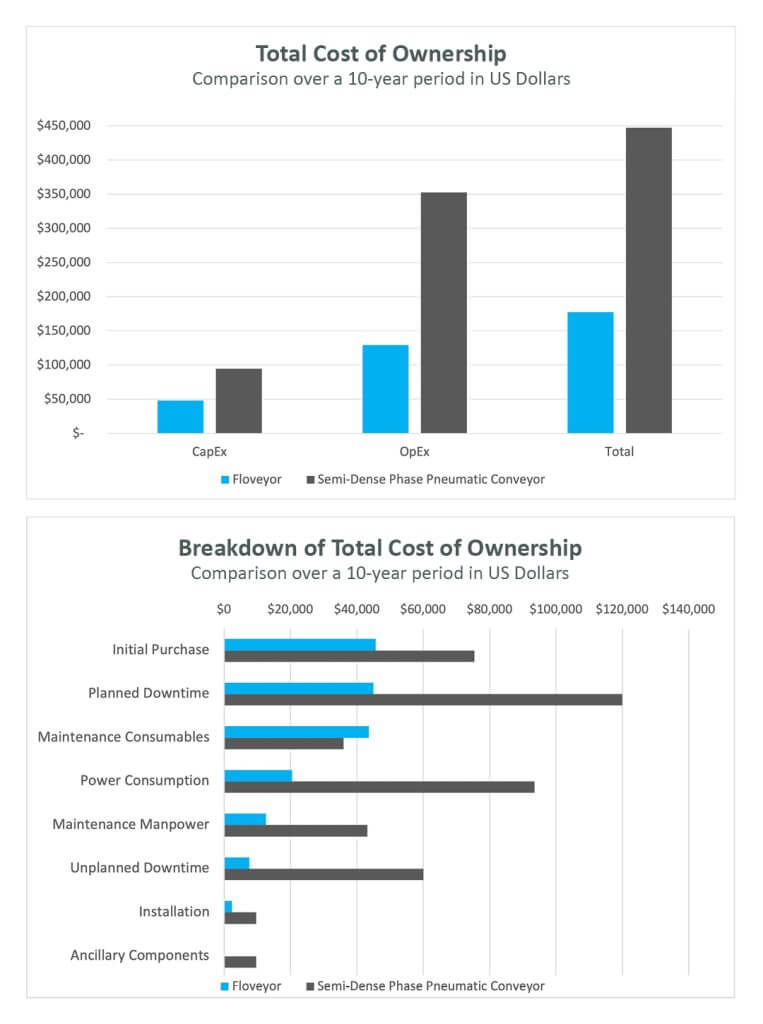
Membandingkan AMC dengan pneumatik apabila mengangkut gula granul sebanyak 20 tan sejam (22 tan sejam).
Jumlah kos pemilikan: konveyor aero-mekanikal vs pengangkat baldi
Dalam aplikasi ini, AMC dibandingkan dengan konveyor elevator baldi.
80 tph (88 stph) pril urea
- Penyuapan: Pemakan pemunggahan lori
- Pemasukan: Penyesuai untuk sambungan proses
- Pelepasan: Inlet silo penyimpanan pada ketinggian 15 m
- Kadar aliran: 80 tan (88 tan pendek) sejam
Konveyor aeromekanikal
- Tiub penghantar 5 inci
- Bahan kontak keluli tahan karat 316
- Struktur keluli tahan karat 316
- 55′ (16.8 m) panjang
- termasuk aksesori cucian kering
Konveyor elevator tong
- Didorong oleh rantai, baldi boleh diganti
- Bahan kontak keluli tahan karat 316
- Struktur keluli tahan karat 316
- 55′ (16.8m) panjang
- s/d sokongan struktur
Apabila dibandingkan dengan a pengangkut timboi, sebuah penghantar aeromekanikal memerlukan jam kerja penyelenggaraan yang jauh lebih sedikit.
Sepanjang 10 tahun, konveyor aero-mekanikal Floveyor mempunyai jumlah kos pemilikan sekitar US$163,000, berbanding dengan kira-kira US$432,000 untuk pengangkat baldi yang mengendalikan aplikasi yang sama — lebih rendah sekitar 62%. Penyumbang terbesar ialah:
- tenaga kerja penyelenggaraan (kira-kira 6.7x lebih rendah)
- masa henti tidak dirancang (kira-kira 9 kali lebih rendah)
- masa henti yang dirancang (kira-kira 5.5 kali lebih rendah).
Floveyor mempunyai jumlah yang lebih rendah bagi setiap baris kos individu yang ditunjukkan.
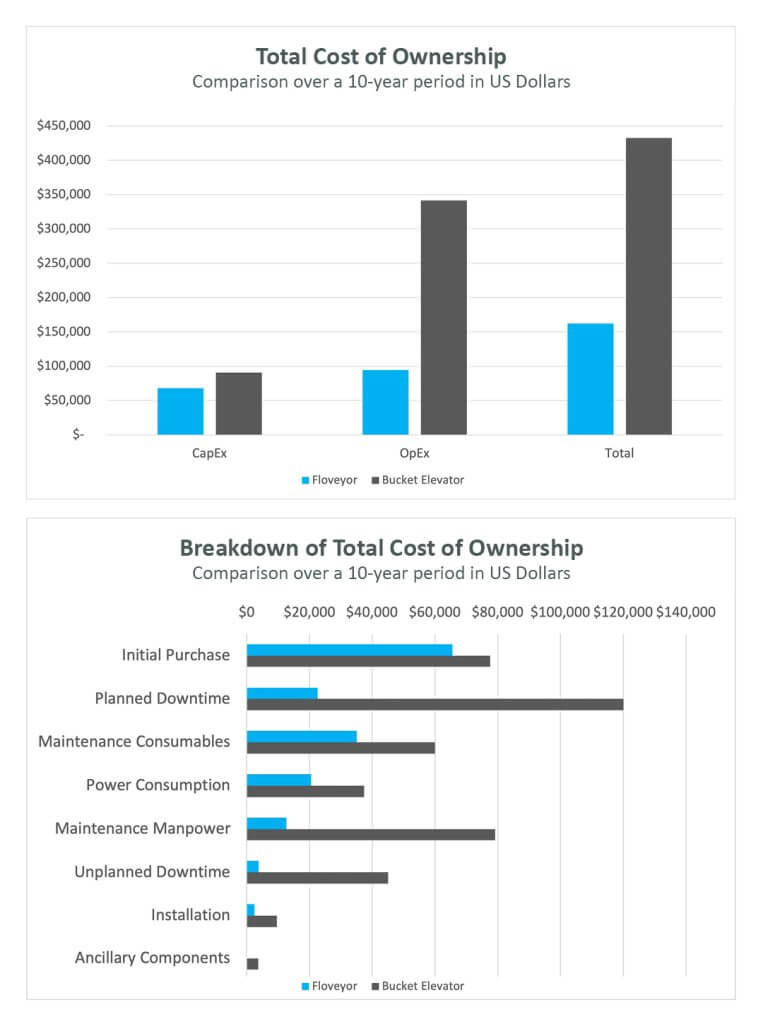
Membandingkan AMC berbanding elevator baldi untuk penghantaran urea prill 80 t/j (88 st/j)
Jumlah kos pemilikan: konveyor aero-mekanikal vs auger fleksibel
Dalam aplikasi ini, AMC dibandingkan dengan auger fleksibel (konveyor skru).
8 tph (8.8 stph) nutrien haiwan
- Pemasukan: beg pakai buang 25 kg
- Pemasukan: Stesen pelupusan beg terbina dalam
- Pelepasan: Inlet pengadun pada ketinggian 5 m
- Kadar aliran: 8 tan (8.8 tan pendek) sejam
- Bahan-bahan: Nutrien haiwan – difosfat kalsium, oksida magnesium, Acid Buf, monohidrat sulfat zink, garam, sulfat tembaga
Konveyor aeromekanikal
- Tiub penghantar 3 inci
- Bahan kontak keluli tahan karat 304
- Struktur keluli lembut yang dicat
- 20′ (6.1 m) panjang
- dengan stesen pelupusan beg terintegrasi
Auger fleksibel (konveyor skru)
- Tiub penghantar 4 inci
- Bahan sentuhan plastik
- Struktur keluli lembut yang dicat
- 20′ (6.1 m) panjang
- dengan stesen pelupusan beg terintegrasi
Konveyor aero-mekanikal Floveyor mengatasi sekrup pengumpan fleksibel pada kos pemilikan keseluruhan. Sepanjang 10 tahun, Floveyor AMC mempunyai jumlah kos pemilikan sekitar US$93,000, berbanding kira-kira US$148,000 untuk auger fleksibel yang mengendalikan aplikasi yang sama, iaitu kira-kira 37% lebih rendah.
Kos modal pada dasarnya adalah sama antara kedua-dua mesin. Perbezaan antara AMC dan auger fleksibel terletak pada kos operasi:
- masa henti yang tidak dirancang (kira-kira 6 kali lebih rendah)
- masa henti yang dirancang (kira-kira 50% lebih rendah).
Auger fleksibel sedikit lebih murah dari segi bahan habis pakai dan penggunaan kuasa, tetapi penjimatan kos masa henti jauh melebihi kedua-dua item tersebut.
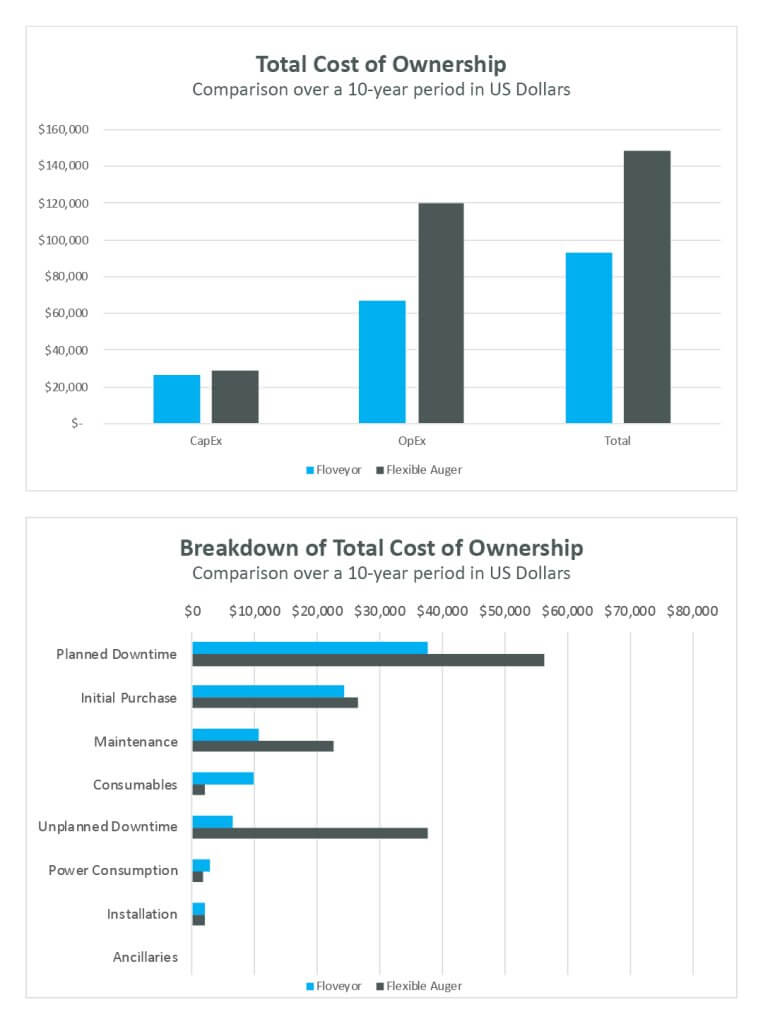
Membandingkan AMC berbanding auger fleksibel (konveyor skru) apabila mengangkut 8 tph (8.8 stph) nutrien haiwan: difosfat kalsium, oksida magnesium, Acid Buf, monohidrat sulfat zink, garam, sulfat tembaga
Apakah penyelenggaraan yang diperlukan oleh konveyor aero-mekanikal?
Konveyor aero-mekanikal memerlukan penyelenggaraan minimum. Penyelenggaraan pencegahan secara berkala menghapuskan masa henti tidak dirancang yang mahal semasa pengeluaran. Pengilang akan mengesyorkan selang masa pemeriksaan dan pelarasan untuk:
- Pemasangan tali
- Sambungan sproket
- Galas berkelajuan tinggi
- Penyegel berkelajuan tinggi
- Permukaan dalaman rumah
- Keteguhan pengikat
- Segel lain.
Jarak masa penyelenggaraan berbeza-beza bergantung pada aplikasi, bahan yang diendalikan dan jam operasi. Floveyor AMC menyediakan akses pantas ke kawasan yang memerlukan pembersihan, pemeriksaan atau penyelenggaraan kerap. Apabila diselenggara dengan baik, Floveyor AMC boleh beroperasi sehingga 24 jam sehari. Satu set tali akan bertahan 3,000–5,000 jam operasi apabila pengangkut dipasang dan dioperasikan dengan betul. Adalah biasa bagi AMC Floveyor beroperasi selama beberapa dekad dengan masa henti minimum dan kadar ketersediaan yang tinggi.
Meningkatkan konveyor aero-mekanikal pusaka anda
Jika anda menjalankan Floveyor AMC lama (dibina antara 1973 dan 2015), meningkatkan kepada reka bentuk generasi baharu (2015–kini) boleh menyediakan keberkesanan peralatan keseluruhan (OEE) yang lebih tinggi dan mengurangkan kos operasi penyelenggaraan dengan ketara.
Rumah bekalan dan pelepasan cor, flens tri-clover dan tiub SS304 menggantikan meterai gasket buih lama, mengurangkan kebocoran habuk dan kekerapan pembersihan manual. Sistem ketegangan elektrik membolehkan seorang pengendali tunggal melaraskan rumah pelepasan tanpa bekerja di tempat tinggi, manakala sproket tanpa web yang dikunci dengan topi boleh ditukar di tapak dengan satu kunci inggris sahaja, bukannya menanggalkan keseluruhan poros. Secara kolektif, kemas kini ini dapat meningkatkan kadar bekalan sehingga 10% dan mengurangkan sisa sebanyak 20-25TP3T, memanjangkan masa operasi pada peralatan yang sudah dibina untuk beroperasi selama berdekad-dekad.
Penyelesaian dan konfigurasi tersuai
Peralatan pengendalian bahan pukal tersedia untuk melengkapi konveyor aero-mekanikal, termasuk:
- Konveyor geseran tiub
- Sistem mudah alih
- Pemunggahan lori
- Pengosong beg pukal boleh guna semula
- Pengosong beg pukal pakai buang
- Pemakanan skru pembongkaran beg pukal
- Pemberi skru AMC
- Pengumpan skru alur
- Pengumpan skru dos
- Penghancur gumpalan rotary
- Pengondisi beg pukal.
Sebagai pencipta asal penghantaran aero-mekanikal, Floveyor mempunyai pengalaman luas dalam mereka bentuk sistem pengendalian serbuk khusus untuk melengkapi AMC. Ini melibatkan:
- Pemodelan penemuan dan penyelesaian
- Menerapkan kepakaran untuk membimbing konsep sehingga menjadi kenyataan
- Sokongan global
- Sokongan selepas jualan yang boleh dipercayai.
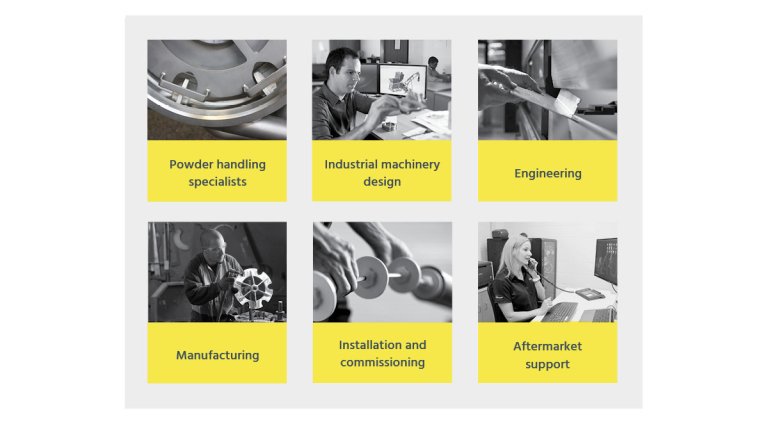
Floveyor pakar pengendalian serbuk
Penyelesaian tersuai mungkin merangkumi saluran khusus aplikasi, hopper dan pemindahan untuk menyepadukan AMC Floveyor standard dan peralatan pengendalian serbuk dengan loji sedia ada atau komponen yang dibekalkan oleh pihak ketiga.
Jika penyelesaian yang disesuaikan sepenuhnya diperlukan, Floveyor boleh mereka bentuk dan membina penyelesaian struktur, mekanikal dan elektrik untuk memenuhi keperluan anda dengan tepat.
Bilakah konveyor aero-mekanikal tidak menjadi pilihan yang tepat?
Terdapat had aeromekanikal pada penghantar, menjadikannya tidak selalu pilihan terbaik untuk setiap aplikasi:
- Panjang lebih daripada 30m/100ft di mana satu larian adalah lebih ekonomik
- Kandungan lembapan melebihi 16% b/b
- Bahan berlemak seperti lilin, berminyak, melekit atau berminyak
- Bahan-bahan yang mengikat di bawah beban mampatan.
Konveyor drag berongga boleh menjadi pilihan yang lebih baik untuk:
- Laluan kompleks dengan pelbagai sudut dan/atau selekoh
- Beberapa kapal terbang
- Beberapa inlet dan/atau titik pelepasan.
Kesimpulan
Konveyor aero-mekanikal adalah tulang belakang sistem penghantaran serbuk di seluruh dunia. Kebolehversatilan, ketahanan dan kos pemilikan keseluruhan yang rendah menjadikannya pilihan menarik untuk pelbagai aplikasi industri dan operasi pembuatan makanan dan minuman. Apabila anda mempertimbangkan keupayaannya memindahkan beribu-ribu bahan dengan pantas, selamat dan lembut menggunakan satu mesin sahaja, AMC adalah pilihan terbaik untuk pengendalian serbuk.
Floveyor mencipta penghantaran aero-mekanikal pada tahun 1958 di Perth, Australia Barat, dan terus membangunkan peralatan penghantaran serbuk. Sebagai pakar pengendalian serbuk, kami boleh membantu anda menemui konveyor serbuk terbaik untuk loji anda, bagi memastikan jangkaan prestasi anda dipenuhi.
Pemadanan bahan kami akan membantu anda menemui AMC terbaik untuk operasi anda.
Hubungi Floveyor untuk mendapatkan nasihat mengenai pengendalian serbuk dan mempelajari cara mengoptimumkan operasi anda untuk hasil dan keuntungan maksimum.

 English
 Chinese
 Dutch
Dutch Finnish
 French
 German
 Hindi
Hindi Japanese
 Korean
 Malay
Malay Polish
 Spanish
 Thai
Thai Vietnamese